.png)
Beating the War Drums... Drama in the Veteran Community
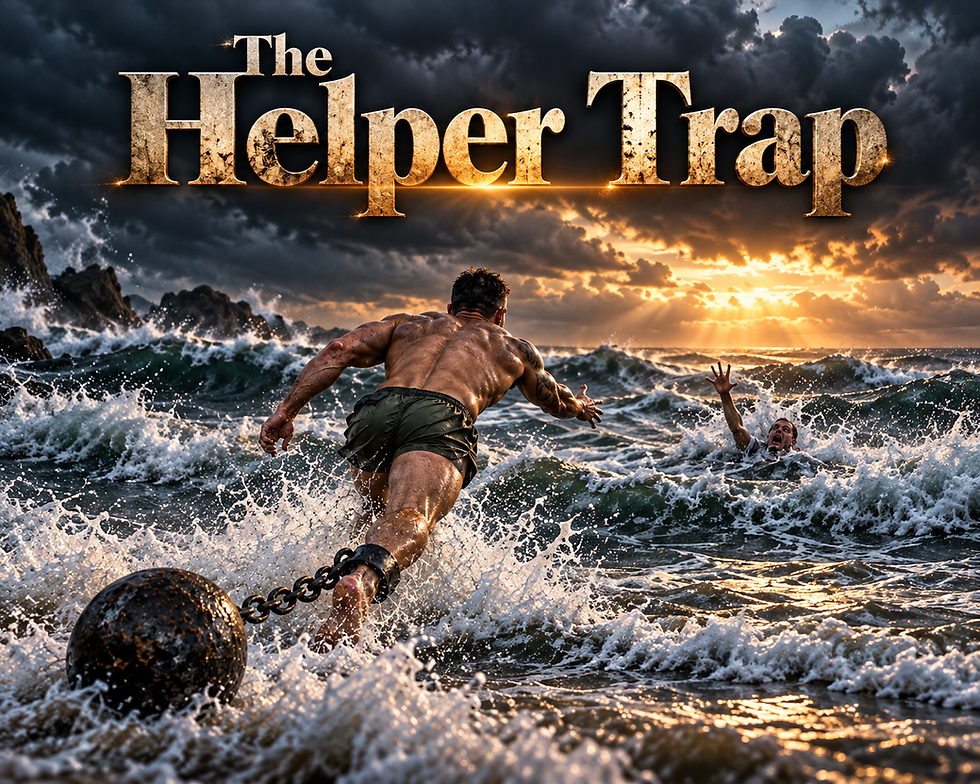
If you've spent any time in a trauma based peer support community… veteran, first responder, recovery, doesn't matter which one, you already know the drama isn't random. It's not "some people are just messy." It's a pattern. Same stages, same order, almost every damn time, whether it's a Silkies hike group chat or a platoon that hasn't seen combat in ten years but still fights like it's on patrol.
Here's the good news. Once you can see the pattern you can interrupt it. That's the whole game. Below is the anatomy of how one ambiguous moment turns into a full blown war party, and where the exits are along the way.
1. Emotional Ambush
Every spiral starts here. A triggering event with incomplete context, where somebody skips a step in discernment. A curt reply. A rejected offer to help. A joke that lands wrong. A missed text. Somebody left off a hike invite by accident.
Nothing has actually gone wrong yet. It's just a gap. What happens next decides everything.
2. The "Jump to Conclusions" Mat
The gap doesn't stay empty long. Someone fills it with a story, and that story almost always gets pulled straight from an old core wound. Abandonment. Betrayal. Being victimized. Not being "enough." The mind fills in the gaps and jumps to conclusions based on neurons in the brain running old code. The story feels true because it's wearing the costume of an old injury. It isn't about the missed text anymore. It's about every damn time this person has ever been left out, overlooked, or discarded.
3. Confirmation Bias
Once the story exists, the brain goes hunting for proof. Every past slight gets reinterpreted as evidence. Anything that would knock the story down, an obvious explanation, a track record of the other guy actually being solid, gets quietly ignored. The story stops being tested and starts being defended like a hilltop.
4. Emotional Contagion / Limbic Hijack
In trauma populations this part moves fast. One person's nervous system drops into fight, flight, freeze, or fawn and it spreads through the group like wildfire. Other people start absorbing the activation before anyone has actually sat down with the person to clarify intent and understanding. The whole room gets dysregulated before a single fact gets checked.
5. Triangulation
Instead of going to the person, the hurt gets dumped on a third party. This is technically where gossip is born, talking about someone instead of to them. It feels safer. It's almost always the single biggest accelerant in the entire spiral, and it's usually where this whole thing could've been shut down if somebody had the balls to just ask the source.
6. The Drama Triangle
The roles lock in. The Victim, "look what they did to me." The Attacker, the original person, now flattened into a villain instead of a human who screwed up. The Superhero, the buddy who "has their back." Watch this one close, because the Superhero flips into the Attacker later once they're tired of carrying someone else's pain.
7. Turning Something Gray into Black and White
This is where nuance dies. The offending person goes from "someone who screwed up" to all bad, evil, cut them off. The Victim becomes the angel who can do no wrong. Sometimes it doesn't stop with the individual, it generalizes to leadership or the whole organization. "This place doesn't have my back."
8. Flying Monkeys
Coalition building kicks off. The Superhero starts recruiting an army. "Did you hear what happened?" They're not looking for resolution. They're looking for soldiers.
9. War Parties
Sides harden into cliques. People who had nothing to do with the original moment get pressured to pick a team. Staying neutral starts to feel like a liability.
10. The Massacre
The group's collective anxiety has to land somewhere, so it lands on one person. Sometimes the original offender, sometimes a leader, sometimes whoever's just easiest to hit. This almost never lines up with what that person actually did. It's the group discharging tension and it needs a target more than it needs the truth.
11. Reenactment
This is the stage everybody misses, and in veteran trauma based communities it's doing the most damage of the whole list. People aren't just reacting to the conflict in front of them. They're re-fighting an old one. A chain of command that failed them. A guy in their platoon who chose sides. A betrayal that never got closed out. The current drama becomes the vehicle for carrying old pain that never had anywhere to land. Once you see this stage clearly, half the fight in the room stops being about the thing everyone's actually yelling about.
12. All Out War
Public callout. Full blown confrontation. Somebody gets banished, or bails/quits (surrenders) before they can be pushed out.
13. Aftermath: Trauma Bonding
The group settles down, but around a shared "us vs them" story instead of any real resolution. It feels like cohesion. It feels like closeness. It's trauma bonding, and it quietly loads the mag for round two.
Why This Matters at Irreverent Warriors
We see this shit constantly and we're not pretending we're above it. We're humans running on the same nervous systems as everybody else in this community. What's different is our leadership catches the pattern early, usually somewhere between stage 4 and stage 6, before it's had a chance to metastasize into a full War Party.
When we spot it we don't let it run its natural course. We shut it down on purpose:
Difficult conversations instead of triangulation. We push people straight back to the source. Go talk to the human, not about the human.
Accountability instead of scapegoating. Real accountability is specific and proportional. A Massacre is neither. It's the group looking for relief, not the truth. We go after the truth.
Forgiveness instead of black and white splitting. People get to be gray. A guy can screw up and still be a solid dude who's earned everybody's trust. Holding both of those at once is the whole point of a brotherhood that's actually trauma informed instead of just trauma adjacent.
True healing instead of trauma bonding. A group that stabilizes around a shared enemy isn't healed, it just found a new way to stay activated together. We want the real thing. Folks who can sit across from each other, say what actually happened, and walk away still brothers and sisters.
The Drama Triangle, the Flying Monkeys, the Reenactment, none of it makes somebody a bad person or a "difficult person." It's what unprocessed pain does when it gets handed an ambiguous moment and no framework to stop it. Naming the pattern out loud, in the moment, is one of the most powerful tools we've got. More times than not, once someone realizes their fighting a ghost from an old deployment or an old relationship, and not the person standing in front of them, the whole damn thing deflates on its own.
That's the hard work. Not killing off drama completely, because that's not realistic with any group of humans carrying what this community carries. The job is catching it early, calling it by name, and choosing the harder (more loving) path every fucking time.
Semper Silkies. Always Healing.